- Home
- About TUAI
- Research
- Doctoral Candidates
- Networking
- Consortium
- Contact

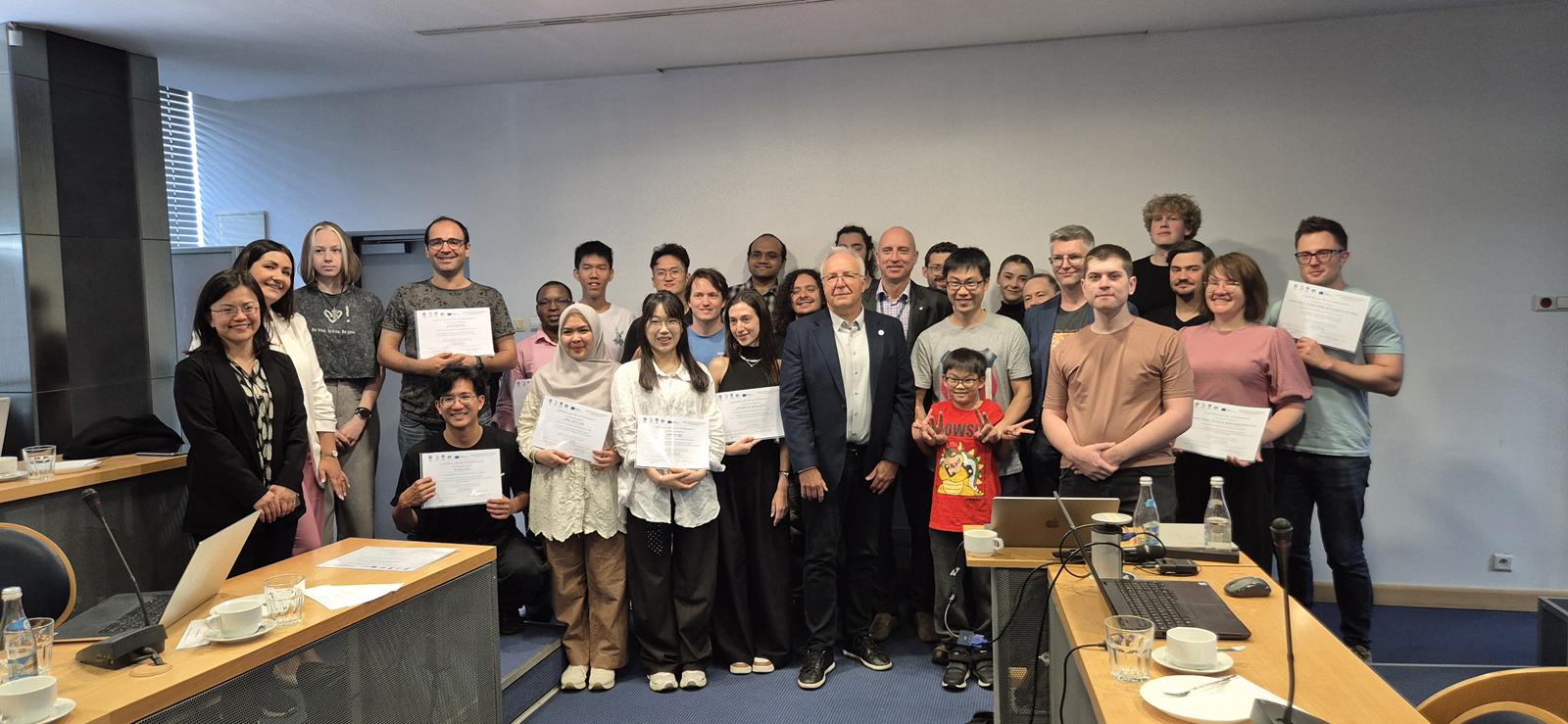
The TUAI Summer School on Sensor Fusion was organised by the Silesian University of Technology (SUT) in Gliwice, Poland, on 20–24 July 2026. The event brought together doctoral candidates, academic supervisors, external advisors, invited experts and participants from TUAI partner institutions, as well as representatives of the Associated Partner Lviv Polytechnic National University (LPNU). The programme combined research presentations, invited lectures, student project presentations, collaborative activities and a panel discussion.
Doctoral candidates’ research presentations and expert feedback
All doctoral candidates (DCs) participating in the TUAI network presented their research during the Summer School. The presentations were organised thematically according to the network’s Work Packages (WPs), allowing each candidate to discuss their individual research project in relation to the broader objectives of the relevant WP and to highlight its specific contribution to the network’s research agenda. An important role was played by the TUAI External Advisor, the Ethics Advisor and the invited industry expert, who provided feedback and contributed their scientific, ethical and practical perspectives. Each presentation was followed by an extended discussion involving the experts, other doctoral candidates and the wider audience. These discussions formed a substantial part of the programme, providing an opportunity to examine research assumptions, discuss methodological choices, challenge preliminary findings and identify potential directions for further work. The exchange of perspectives also encouraged interaction between doctoral candidates working on complementary topics and helped connect individual research projects with the wider scientific and application-oriented objectives of TUAI.
WP2 – Research Progress: Presentations by DC1–DC4
WP3 – Research Progress: Presentations by DC5–DC7
WP4 – Research Progress: Presentations by DC8–DC10
WP5 – Research Progress: Presentations by DC11–DC12
LPNU Associated Partner Day
The LPNU Associated Partner Day was dedicated to strengthening cooperation between the TUAI network and Lviv Polytechnic National University (LPNU) as an Associated Partner. The event provided an opportunity to present LPNU’s contribution to the network, exchange research perspectives and discuss potential areas for further collaboration. Particular attention was given to connecting the expertise and research activities of LPNU with the scientific objectives of TUAI. The discussions brought together network partners, researchers and doctoral candidates, encouraging the exchange of ideas, the identification of complementary research interests and the exploration of opportunities for future joint activities. The event also highlighted the importance of international academic cooperation and the involvement of Associated Partners in broadening the network’s research and knowledge-sharing activities.
Panel discussion: sustaining doctoral training and research mobility in Europe
An important part of the Summer School was the panel entitled “Sustaining AI Doctoral Training and Research Mobility in Europe: Challenges, Models and Continuity.” The discussion broadened the focus beyond individual research topics to consider the conditions needed to sustain high-quality doctoral training and international research collaboration.
The panel provided a forum for discussing the challenges of maintaining research mobility, cooperation between institutions and continuity in doctoral training. It complemented the technical programme by addressing the wider European research environment in which doctoral networks operate and the importance of maintaining collaborative structures beyond individual project activities.
Professor Jean-Charles Lamirel, affiliated with the Synalp team at LORIA and the University of Strasbourg, is the TUAI External Advisor. His research focuses on machine learning, data mining and the analysis of complex, high-dimensional data, with particular emphasis on clustering, graph and word representations, and interpretable methods.
During the Summer School, Professor Lamirel presented research on methods for analysing complex data and developing efficient and interpretable representations. He discussed the challenges associated with high-dimensional datasets, including the limitations of conventional distance-based methods, the evaluation of clustering results, the selection of informative features and the interpretation of patterns identified by machine-learning algorithms. Particular attention was given to the Feature Maximization (F-max) metric, which combines feature recall and feature predominance to identify properties that meaningfully characterise data clusters. He explained how this approach can support classification, incremental clustering and complex data analysis, and how it can be extended to identify community roles in networks and construct sparse representations of graph nodes and words. The examples illustrated how graph structure and word co-occurrence can be exploited to obtain compact representations that retain meaningful relationships while improving interpretability and computational efficiency.
The presentations also addressed the broader relationship between graph analysis, text processing and interpretable embeddings. Professor Lamirel discussed how sparse representations derived from graph communities and word co-occurrence patterns can support the analysis of relational and textual data, and why embedding methods should be evaluated not only in terms of predictive performance but also in terms of the meaningfulness and interpretability of the resulting representations. A further research direction concerned the potential application of F-max to auditing features extracted by sparse autoencoders in large language models. The proposed approach aims to assess whether individual features correspond to coherent concepts by analysing the properties of the examples that activate them most strongly. This topic connected established work on interpretable clustering with current challenges in understanding the internal representations of language models. Together, the lectures provided doctoral candidates with methodological perspectives on feature analysis, representation learning and interpretability, relevant to the development and evaluation of trustworthy AI systems.
Professor Przemysław Biecek, the TUAI Ethics Advisor, is a professor at the University of Warsaw and Director of the Centre for Credible Artificial Intelligence at Warsaw University of Technology. He leads the MI².AI research group, which develops methods and tools for responsible and explainable machine learning. His research focuses on explainable AI, the interpretability and evaluation of machine-learning models, and methods for assessing their reliability and trustworthiness. His work combines statistical and computational approaches to understanding model behaviour and supporting the responsible development and deployment of AI systems.
During the Summer School, Professor Biecek delivered a doctoral seminar entitled “Explainability in AI: A Survey of the Research Frontier”, providing an overview of developments in explainable AI between 2023 and 2026. The lecture examined the evolution of explainability methods, from post-hoc feature attribution techniques such as LIME, SHAP and Integrated Gradients to mechanistic interpretability approaches aimed at understanding the internal representations and computational mechanisms of complex models, including large language models. He discussed concept-based and causal methods, applications beyond language models, and the challenges of evaluating the quality and reliability of explanations. Particular attention was given to the limitations of established techniques, including their sensitivity to reference distributions, the possibility of generating misleading explanations, and the risk that apparently accurate models may rely on irrelevant correlations rather than meaningful features. The seminar also explored emerging approaches based on sparse autoencoders and the open research questions surrounding the interpretability of foundation models. It encouraged doctoral candidates to critically assess explanation methods and distinguish between plausible explanations and evidence that genuinely reflects model behaviour.
In addition to the lecture, Professor Biecek conducted an ethics workshop in which doctoral candidates worked in groups to analyse and address selected ethical problems related to AI. The group-based format encouraged participants to examine the problems from different perspectives, discuss potential consequences and consider how ethical principles can be translated into practical decisions in AI research and applications. The workshop complemented the theoretical seminar by giving participants an opportunity to engage actively with ethical dilemmas and reflect on the responsibilities involved in developing and deploying AI systems. Together, the lecture and workshop supported the TUAI network’s objectives of promoting explainable, trustworthy and responsible AI, combining critical understanding of technical methods with practical consideration of the ethical implications of AI-based solutions.
Dr Mühenad Bilal presented the process of translating a research idea into an industrial innovation, illustrating the journey from identifying a practical problem and conducting research to protecting intellectual property and pursuing commercialisation. His presentation used the example of his doctoral research at the Technical University of Ingolstadt (THI), which addressed the automated inspection and classification of complex, highly reflective cutting tools used in industrial manufacturing.
The case study demonstrated how an industrial need can provide the starting point for applied research. In collaboration with Linner Werkzeugfabrik GmbH, the work addressed the limitations of conventional tool-inspection methods, which can be time-consuming, costly and dependent on specialised expertise. The research led to the development of a specialised optical imaging system designed to reduce unwanted reflections and provide homogeneous illumination, enabling reliable image-based analysis. This imaging technology was combined with convolutional neural networks (CNNs) to detect and classify tool wear, illustrating how an initial technical concept can evolve into an integrated solution addressing a real manufacturing challenge.
An important element of the presentation was the pathway from technical development to intellectual-property protection and potential market application. The doctoral research provides a concrete example of this process: the specialised illumination technology was patented in Europe (EP4130720), while its development involved collaboration between the university and an industrial partner, as well as support for patent applications and advice on commercialisation. The example highlighted that successful innovation requires more than a promising research result. It also involves identifying an industrial need, developing and validating a technical solution, protecting the resulting intellectual property, and working with industrial partners to prepare the technology for practical adoption. The lecture offered TUAI doctoral candidates insights into the challenges and opportunities involved in moving from an academic research idea towards an industrially relevant innovation.